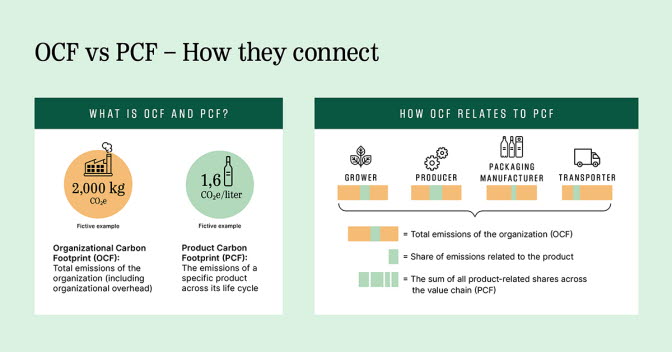
Click on the graphic to get a higher resolution in pdf.
An Organizational Carbon Footprint (OCF) describes the total climate impact of an organization during a specific period, typically one year. It includes emissions from all activities across the organization.
For a beverage producer, this may include the beverage production, offices and staff activities, if there are visitor facilities such as tasting rooms and restaurants or other hospitality activities.
An OCF should ideally also include emissions from purchased goods and services, although this is not always the case. OCF calculations provide an important overview of an organization’s overall climate impact and help identify opportunities to reduce emissions across the business.
A Product Carbon Footprint (PCF) looks at emissions from a different perspective. Instead of measuring the impact of the entire organization, it focuses on the emissions linked to a specific product over its entire life cycle. For a beverage producer, this means identifying the share of the organization’s activities that relate directly to producing that beverage.
Some resources—such as electricity, water use, or buildings—support several activities within the organization. In these cases, emissions need to be allocated, meaning that a proportional share is assigned to the product.
Emissions from unrelated activities, such as a tasting facility or restaurant, should not be included.
How OCF and PCF work together
The same approach is then applied throughout the supply chain: Each organization involved contributes to the share of emissions linked to the product. When these contributions are combined, they form the product’s total carbon footprint.
In other words, a Product Carbon Footprint is built from small shares of several organizations’ carbon footprints, connected across the value chain.
From measurement to action
Creating a Product Carbon Footprint (PCF) is the first step toward meaningful climate action. When data from across the value chain is brought together, it becomes possible to analyze the product’s footprint, understand what drives emissions, and identify where improvements can have the greatest effect.
From there, suppliers across the value chain can work together to reduce emissions—focusing efforts where they make the most difference.